Stepping aboard the evening inner-harbor commuter ferry
Across the Bosporus, daily transit doubles as an unhurried communal parlor of tea glasses and salt spray.
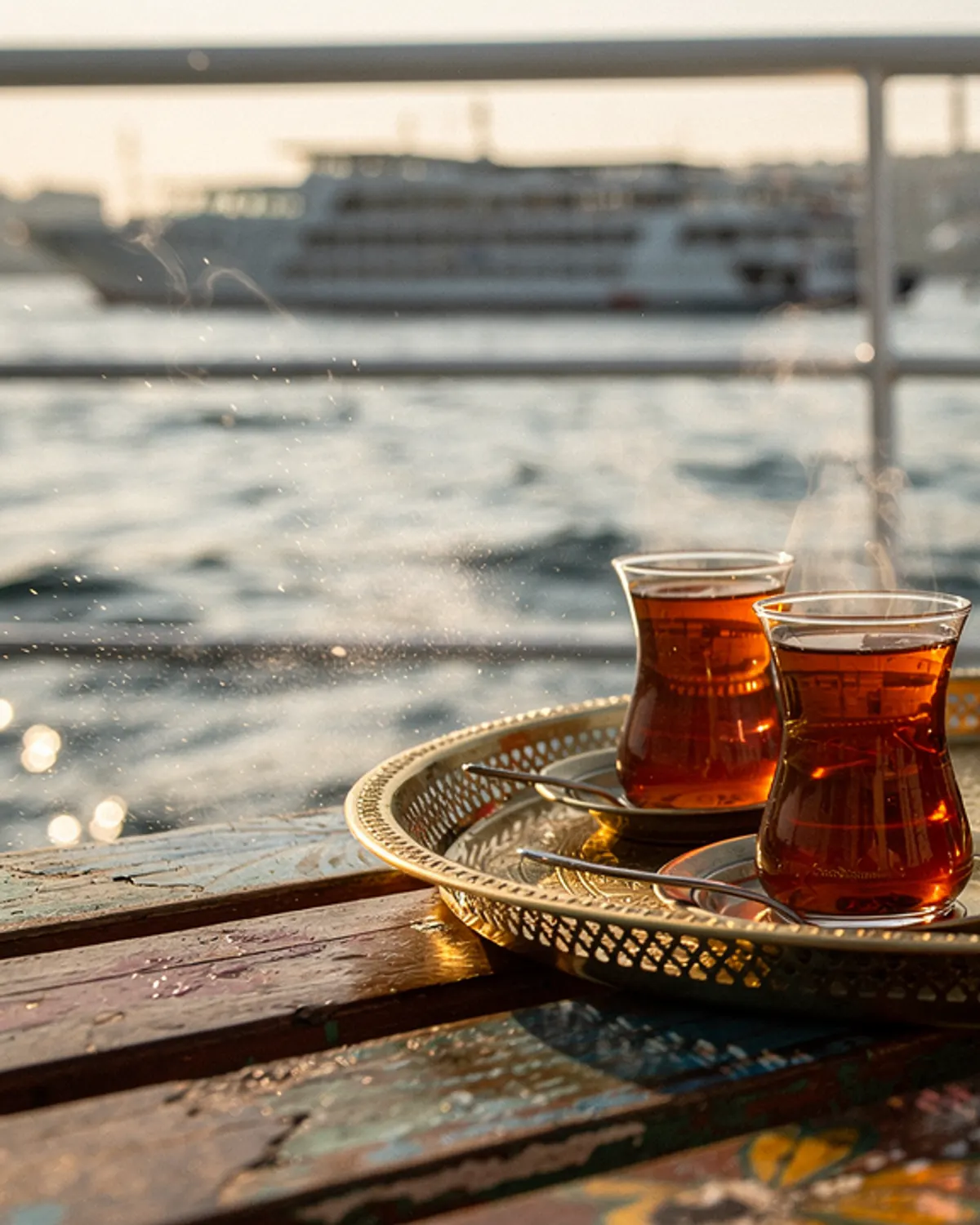
Illustration. Stepping aboard the evening inner-harbor commuter ferry
The turnstile clicks with a hollow mechanical snap, and the air immediately changes from bus exhaust and roasted chestnut smoke to harbor brine. In Istanbul, the commuter ferry remains the city's gentlest antidote to road congestion. Stepping across the ribbed steel gangway onto the polished teak deck of an old steamship is an act of deliberate decompression. Engines thrum through the soles of your shoes, a steady, low-frequency pulse that settles the nervous system after a day of pavement walking.
Commuters distribute themselves with practiced instinct. Those who want silence head upstairs to the enclosed salon, where velvet-cushioned benches face dark mahogany window frames. Those who want air drift aft, standing along the brass railing or tucking into low wooden benches beside the lifebuoys. A deckhand casts off the heavy mooring hawser with a dull thud against the timber dock, and the vessel glides back into the current, turning its bow toward the opposite shore.
The rhythm of the tea tray
Before the ferry has cleared the harbor buoy, the tea vendor appears from the lower companionway. He carries a suspended nickel-plated tray balanced on three brass chains, loaded with tulip-shaped glasses of hot black tea (*çay*), each resting in a red-and-white porcelain saucer with two sugar cubes. He moves across the rolling deck with sea legs honed by decades of swell, his fingers casually wedged between boiling glasses without scalding.
Taking a glass is simple courtesy and cheap comfort. You tap two coins on the rim or hand over a small note, take the saucer, and balance it on your knee. The tea is strong and clear, amber against the evening light. Beside you, an office worker opens an evening paper, an elderly woman in a woolen coat feeds crusts of sesame bread to stray gulls drafting in the boat's slipstream, and nobody rushes. The crossing takes twenty minutes, and for those twenty minutes, no one can demand anything from you.
Shared silence on open water
What makes the ferry peculiar is its quiet sociability. On buses and underground trains, passengers shrink into coats and screen glares. Here, people look outward. They watch freight vessels riding low in the navigation lane, the flight paths of cormorants skimming the chop, and the amber lanterns of wooden fishing skiffs anchored off the rocks. If someone asks for a spare sugar cube or slides over to make room on a crowded bench, it is done with a slight nod of acknowledged kinship.
Ferry regular Selçuk Bey, who has crossed between Kadıköy and Karaköy five days a week since his youth, once explained that the boat belongs to neither bank. 'On the pier you are late, and at home you have duties,' he told me, stirring his third glass. 'On the water, you are simply between places. That space belongs entirely to you.' His observation rings true on autumn crossings, when mist blankets the minarets and the vessel seems to suspend both time and geography.
Arrival at the wooden pilings
The whistle sounds two short blasts as the boat approaches the slipway. In the wheelhouse above, the captain shifts the heavy brass telegraph to reverse; water boils white under the stern, churning up sea grass and cold spray. The vessel cushions against creosote-soaked timber fenders with a deep, groaning creak that resonates through the entire hull.
Ropes are thrown, the iron gates rattle open, and the crowd surges forward in a single cohesive wave across the gangplank into the street. The harbor air recedes, replaced by roasted corn carts, idling taxis, and the chatter of sidewalk cafes. Yet that twenty-minute interlude remains lodged under your ribs, a lingering pocket of maritime quiet that carries you through the evening.