Breaking warm sourdough into fresh early-harvest olive oil
In northern Aegean olive country, pressing days conclude around a shared plank table with raw oil and rock salt.
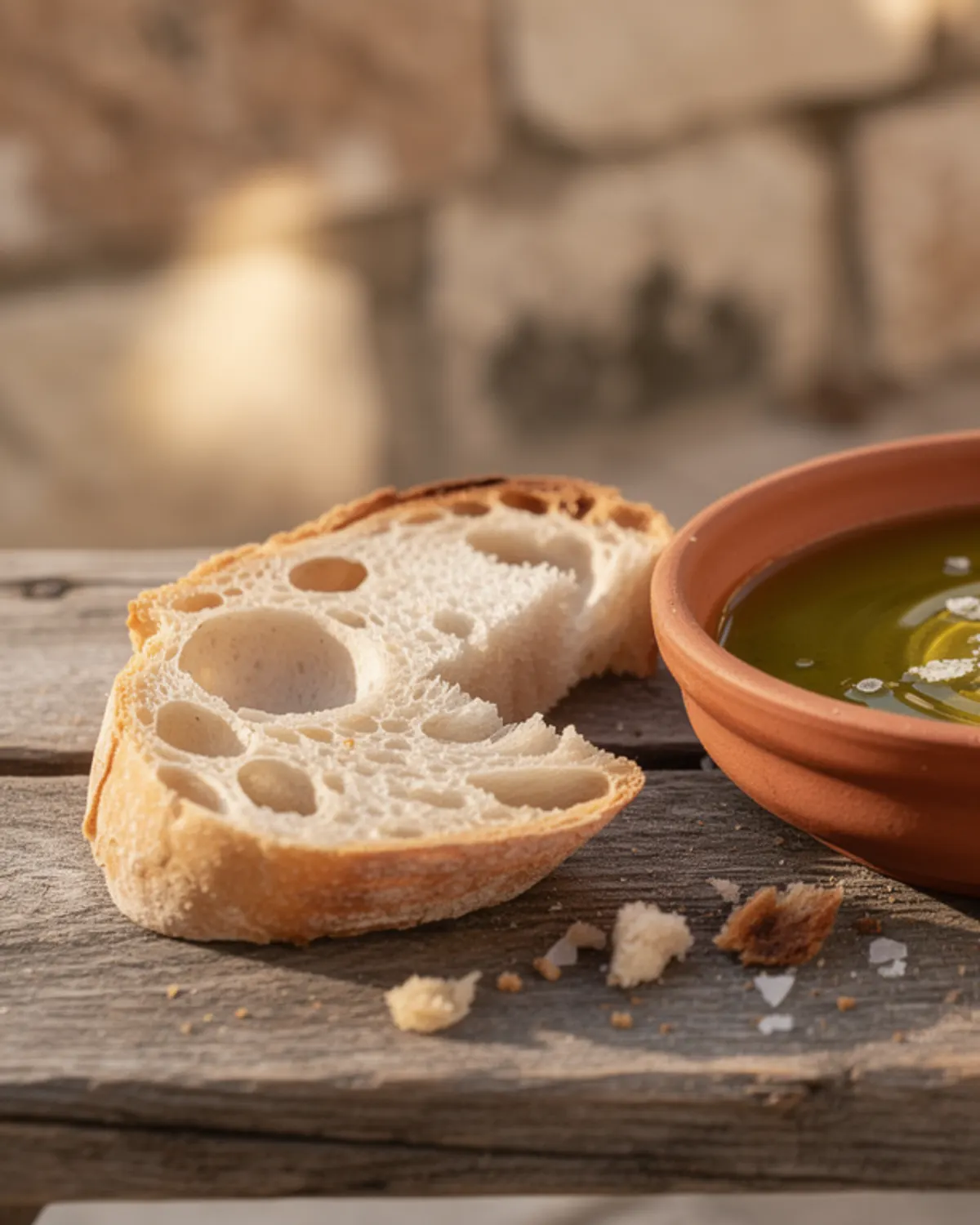
Illustration. Breaking warm sourdough into fresh early-harvest olive oil
The air around the stone mills of Ayvalık at this time of year carries an aroma unlike anything found in a city kitchen. It smells of freshly sheared grass, crushed green tomato leaves, and warm damp earth. Outside the press house, tractor trailers spill over with rough burlap sacks of hand-picked olives, small and purple-green, their stems still bearing silver-backed leaves. Inside, the heavy granite rollers grind the fruit into a glistening, dark violet paste.
Harvest days are physically relentless, beginning at dawn under the coastal fog and ending after dark beneath buzzing workshop bulbs. But the culmination of the day is an ancient, almost sacred domestic pause: tasting the cold trickle of newly separated oil before it settles or clarifies in cellar tanks. It is an immediate reckoning with the season's weather, rain patterns, and soil.
The mechanics of the first press
Centrifuges hum quietly, replacing the woven esparto grass mats of old while preserving the fundamental mechanics of extraction. The oil emerges from a stainless steel spout as an opaque, luminous chartreuse ribbon, frothing gently as it fills stainless steel buckets. There is no filtering here; tiny suspended particles of olive pulp give the liquid a cloudy density that coats whatever it touches.
Local grower Sevim Hanım stands by the collection vat with a ceramic bowl and an earthenware pitcher. 'You cannot judge an oil from a bottle three months later,' she says, dipping the lip of the bowl under the tap. 'You judge it here, while the friction of the stone is still warm in the juice. If your throat does not tingle, the tree was sleeping.' Her hands, stained dark by tannin and orchard clay, hold the bowl with practiced reverence.
Bread, salt, and the peppery sting
To taste early harvest oil properly requires only two accompaniments: thick hearth-baked sourdough bread with a scorched crust, and coarse gray sea salt raked from the Aegean pans. The bread arrives wrapped in a tea towel, hot enough to make the fingers dance. We tear it by hand into ragged chunks, leaving the crumb open to drink the green fluid.
You dip deep, soaking the crumb until it sags with weight, sprinkle two pinches of salt, and take a bite. The initial sensation is sweet and silky, tasting intensely of artichoke hearts and green almonds. Then comes the second wave: a sharp, peppery punch at the back of the palate that induces a mandatory, satisfying cough. That bitterness is oleocanthal, the hallmark of unripe fruit picked before autumn frosts soften the flesh.
A seasonal kitchen baseline
By nightfall, workers and orchard owners sit together on low wooden stools, passing glasses of hot black tea and wiping plates clean with crusts until only a pale green glaze remains on the white enamel. There is little talk of market yields or export contracts. Instead, conversations revolve around rainfall in late spring, the wild boars that broke through stone boundary terraces, and which mountain groves produced the strongest pepper bite.
Leaving the mill with a five-liter tin of cloudy oil secured in the back of the car brings a peculiar sense of winter security. The oil will clear in a few weeks, throwing a fine sediment to the bottom of the tin, mellowing into a golden table oil. But for this single evening, raw and unfiltered, it remains the distilled essence of stony hills and sea wind, captured in a cracked ceramic bowl.