Excavations at Bakla Tepe reveal communal hearths and early metal casting molds
Field teams near Izmir have concluded their autumn trench work after uncovering multi-room stone foundations and clay crucibles. The layout points to shared metalworking facilities across several neighboring households.
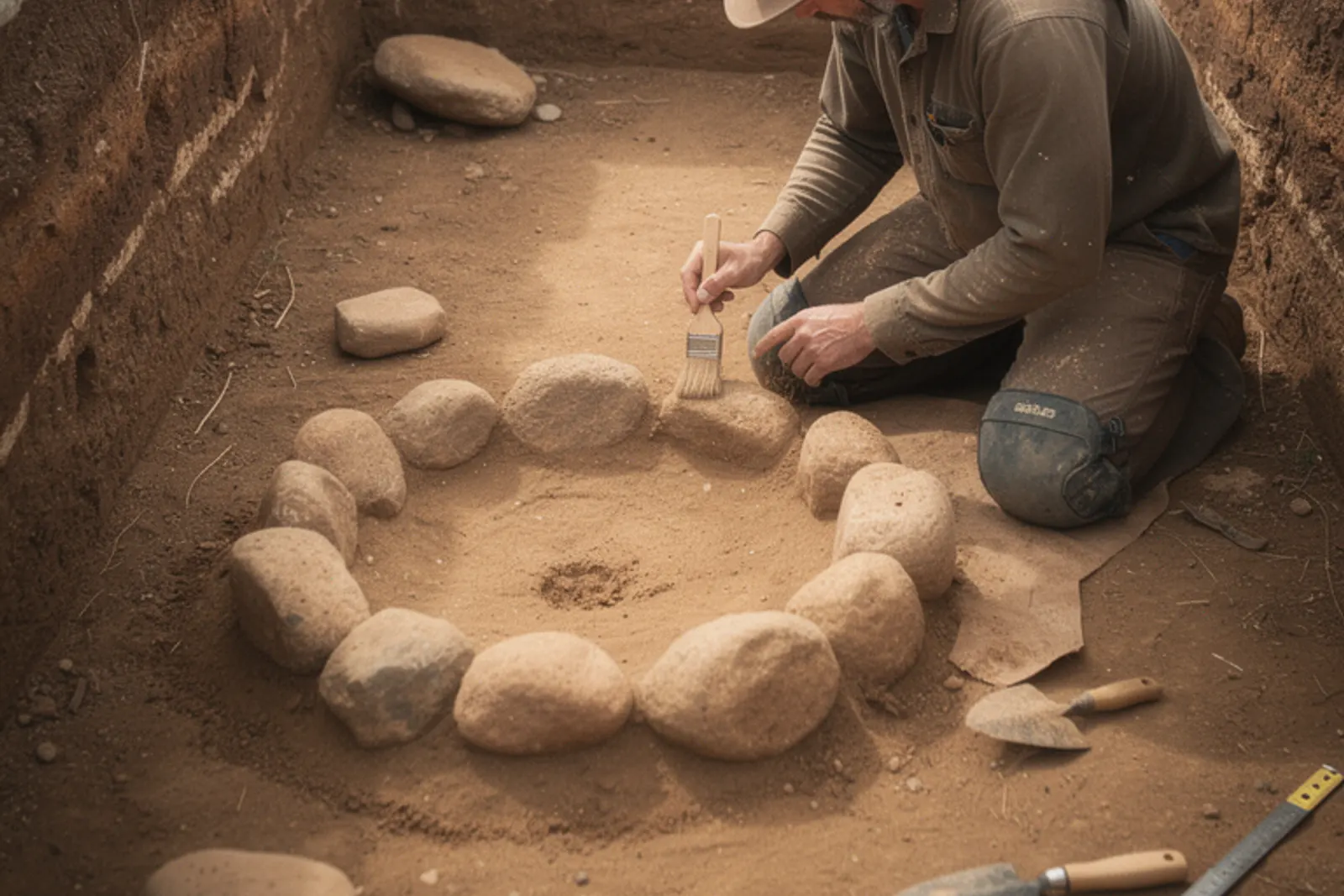
Illustration. Archaeological trench workers clear packed silt from a prehistoric stone hearth on the Bakla Tepe terrace.
Where
Menderes, IzmirAegean region
Field teams working on the western slope of Bakla Tepe completed their seasonal trench clearance this week, exposing an interconnected row of dry-stone foundations. The dig directorate confirmed the discovery of an open-air courtyard paved with rounded river pebbles and packed clay. Beside the central hearth, excavators lifted two intact terracotta crucibles speckled with copper slag. Charcoal samples collected beneath the stone benches will travel to an Aegean university laboratory for compositional analysis.
The trenches sit on an alluvial terrace overlooking the Tahtali river valley, an area long settled for its easy access to arable bottomland and coastal routes. Rather than individual household hearths, the recovered plan suggests neighbors shared smelting fires and heavy stone grinding slabs. Archaeologists worked with fine trowels and brushes to clear thick alluvial silt that had sealed the floor layer undisturbed. The preservation allows researchers to document household organization before winter rains pause site operations.
Shared courtyard work
The domestic architecture features low stone socles that once carried mudbrick superstructures, alongside compacted lime floors renewed across several building phases. In the westernmost room, conservators recorded stone pestles resting inside shallow basalt mortars beside carbonized barley grains. The spatial arrangement indicates that grain preparation and metal melting occurred within steps of each other under a single roof beam network. Water channels carved into the soft limestone bedrock directed rainwater away from the casting pits.
Field notes indicate that copper ores were likely hauled from nearby foothill deposits and processed on site using pine charcoal fuel. Small stone axe blades and bone awls recovered near the perimeter wall suggest steady hide working alongside metallurgy. The team stabilized the fragile clay features with breathable mesh and dry sand bags to protect them from frost over the coming weeks.
“The clustering of casting molds in an open central space demonstrates that metallurgy here was a collaborative village craft rather than a secretive trade.”
Hale Sezgin, field trench supervisor
Finds in the flotation tanks
Soil samples taken from the hearth margins underwent wet flotation at the site camp to retrieve micro-botanical remains and tiny bone splinters. Technicians recovered burnt seeds of bitter vetch, einkorn wheat, and wild grape pips that hint at regional forage patterns. Fish vertebrae from local stream species also appeared across several domestic refuse pits.
Preliminary sorting suggests a diet rooted in small-plot farming supplemented by seasonal freshwater foraging and sheep herding. The flotation process helps researchers reconstruct local plant cover and changes in timber gathering across successive settlement layers.
- Carbonized grain concentrations beside the hearth perimeter
- Basalt casting matrices for small flat adzes and pins
- Polished bone implements with heavy use wear on working tips
Winter site shelter plans
Site conservators have begun erecting lightweight wooden canopies over the deepest trench sectors before cold rains soak the valley. Drainage ditches dug around the excavation perimeter will channel water away from the exposed mudbrick fragments. Regional museum teams plan to dry and consolidate the recovered ceramics inside controlled storerooms through the winter.
Detailed photogrammetry models compiled this season will guide future trench placements along the southern slope when dry weather returns next spring. Researchers hope to follow the line of the terrace wall toward what appears to be an earlier settlement ditch.
Sources
- Bakla Tepe Seasonal Excavation Logbook — Aegean Archaeology Research Collective, Trench West-B Layer IV Summary
Spotted an error? Write to [email protected] — see our corrections policy.