Kneading wet sheep wool into heavy shepherd felt
In a small Aegean workshop, masters still use boiling soapy water and rhythmic foot pressure to bind raw wool.
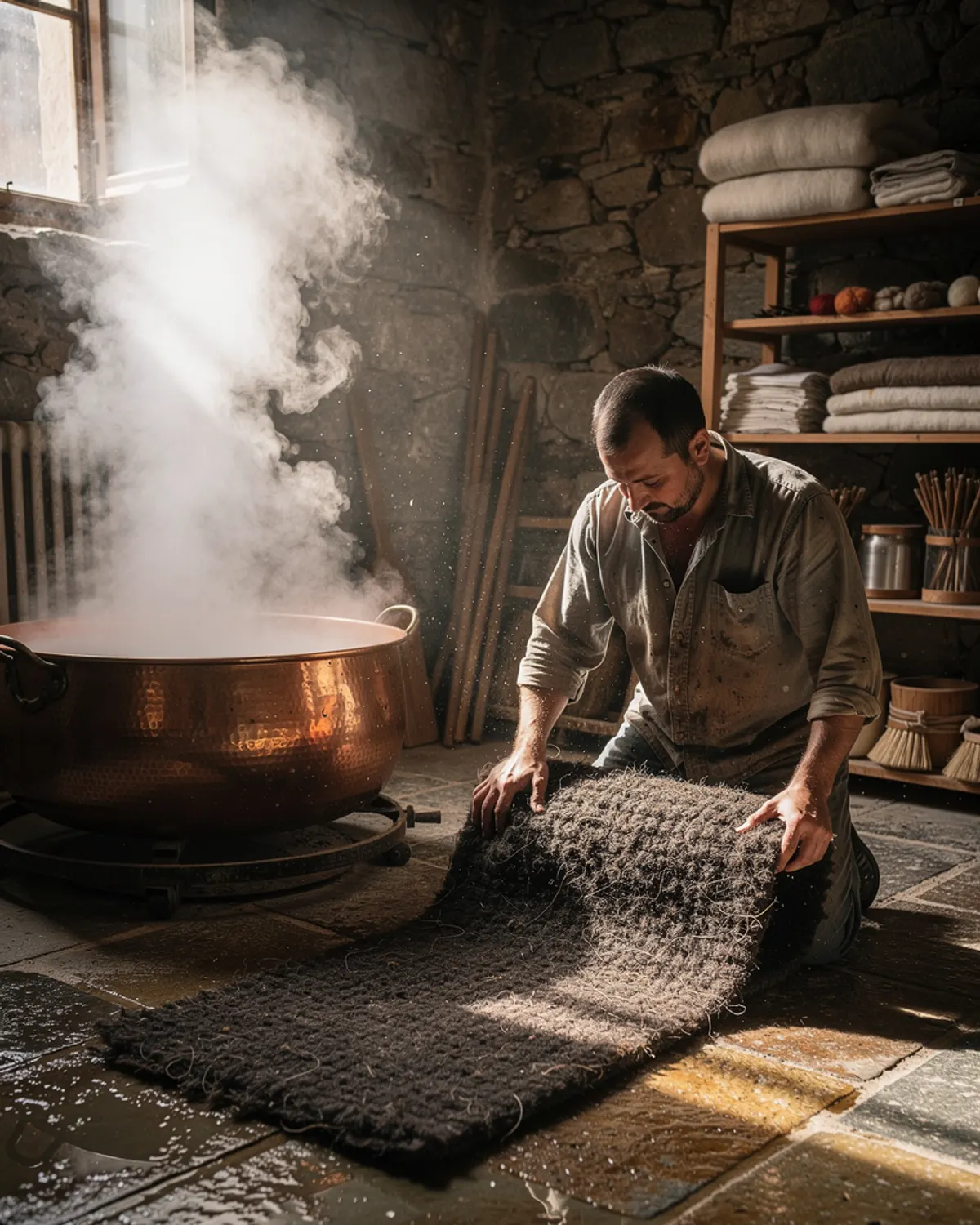
Illustration. Kneading wet sheep wool into heavy shepherd felt
Tire, a market town nestled in the fertile river plains behind Izmir, has long been a sanctuary for traditional crafts that require patience and muscle. Tucked into an alleyway of low clay-tile roofs, the workshop of Halil Usta smells immediately of sheep lanolin, wood ash, and olive-oil soap. The floor is smooth flagstone, worn down by generations of bare feet and constantly wet from boiling water.
Feltmaking (*keçecilik*) is not weaving; it has no warp, no weft, and no loom. It is the ancient art of coaxing loose, curly wool fibers to lock into an impenetrable, solid fabric through the violent combination of moisture, heat, and physical agitation. Long before synthetic waterproof membranes existed, the heavy shepherd’s cloak (*kepenek*) was the only shelter that could keep an Anatolian shepherd dry through three days of continuous winter mountain sleet.
Carding and laying the batting
The work starts on a giant reed mat spread out across the floor. Halil’s apprentice uses a suspended wooden bow with a gut string, striking it with a wooden mallet to fluff the cleaned sheep fleece into airy, cloud-like clumps. These clumps are laid down by hand in thick, crisscrossing layers, often thirty centimeters deep, to produce a finished felt just one centimeter thick.
'Wool has tiny barbs on every fiber,' Halil Usta explains, wiping sweat from his eyebrows with the back of a muscular forearm. 'When the wool is dry, the barbs slide over each other without catching. But when you soak it in hot lye water and roll it hard, those barbs open up like fishhooks and grab their neighbors. Once they take hold, nothing can pull them apart.'
The ritual of foot rolling
Once the wool batting is arranged, Halil sprinkles it with boiling water from a heavy copper kettle, using a stiff brush made of heather twigs to distribute the heat evenly. The reed mat is then rolled tightly around the steaming wool mass like an enormous cylinder, lashed securely with thick hemp rope.
Now begins the wrestling match (*tepme*). Halil and his apprentice kick, stomp, and roll the cylinder back and forth across the stone floor using their heels, knees, and forearms in a rhythmic, sweaty dance that lasts for hours. Steam billows from the ends of the roll, carrying the sour, pungent smell of heated wool fleece. Every half hour, the mat is unrolled, inspected for thin spots, sprinkled with fresh boiling water, and bound up again for another round of compression.
An armor against the elements
By late afternoon, the transformation is complete. Halil unrolls the reed mat to reveal a stiff, seamless white garment shaped like a standing tent, its stiff triangular shoulders molded entirely without scissors or thread. He picks up a heavy brass cup of water and splashes it directly against the chest of the newly finished cloak; the water beads up into silver spheres and rolls off the surface onto the flagstones without leaving a single damp spot.
Holding the finished felt reveals its dense, comforting heft. It is heavy, stiff, and smells unapologetically of mountain meadows and soap. In an era dominated by thin, throwaway garments, holding something beaten out of raw wool by human weight feels like an anchor. It will outlive its maker, protecting a highland shepherd from mountain wind for thirty winters to come.