Milas basket weavers harvest chaste tree branches to restore traditional olive hampers
Artisans along the foothills of the Aegean coast are gathering wild Vitex agnus-castus canes from dry stream beds. The seasonal harvest sustains an ancient weaving technique that produces light, breathable gathering baskets for olive growers.
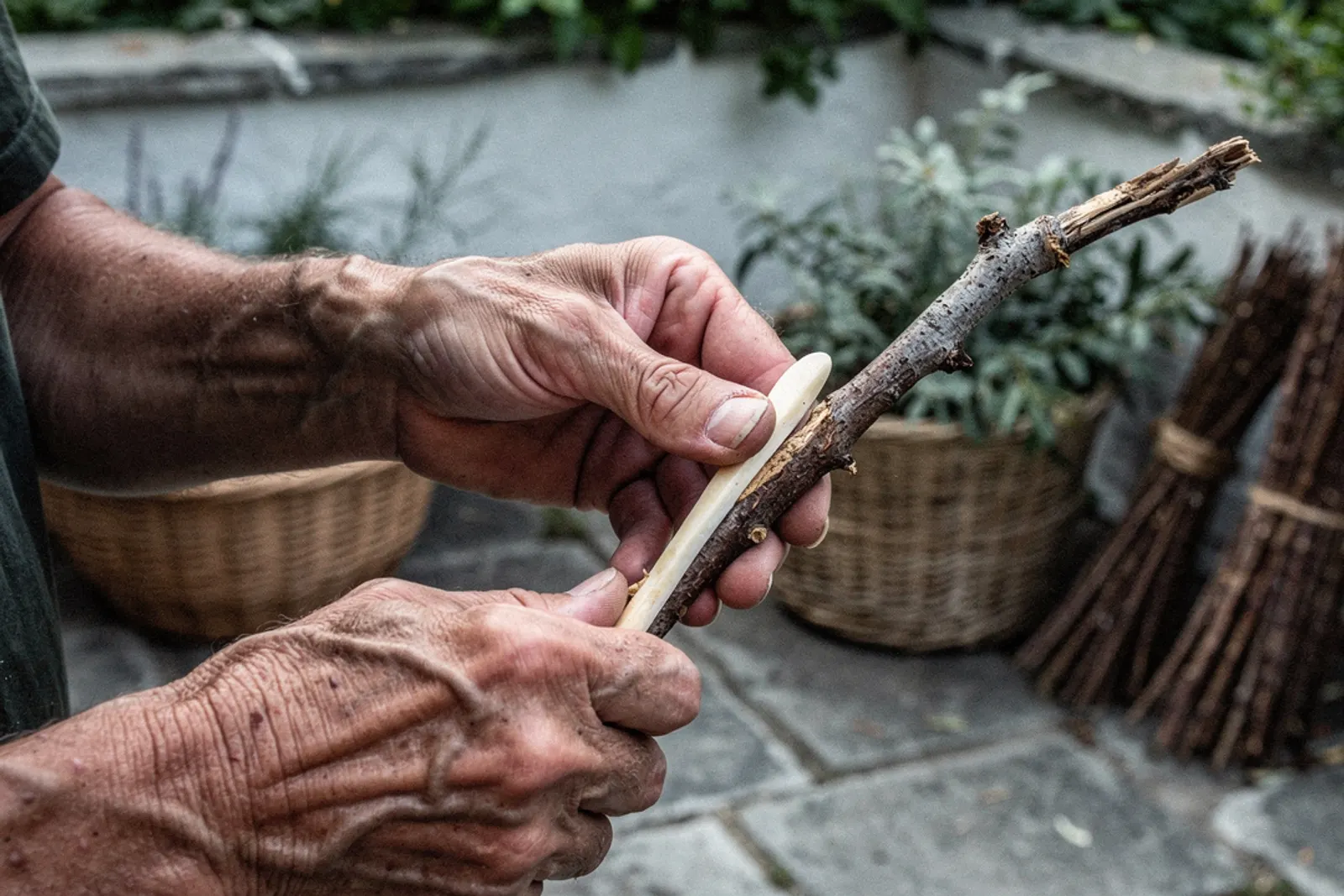
Illustration. A basket weaver splits seasoned chaste tree branches using a handheld wooden wedge in a stone courtyard.
Where
Milas, MuglaAegean region
In the gravelly stream beds running down from the pine ridges near Milas, artisan weavers have begun cutting flexible whips of the chaste tree, known locally as hayit. The pale purple flowering shrubs grow wild along seasonal watercourses, sending up straight, supple shoots that dry to an enduring gray-brown toughness. Gathered in armloads before the autumn rains swell the dry ravines, these wild branches form the structural skeleton of traditional Aegean olive baskets.
The revival of these hand-woven hampers comes as organic olive producers seek plastic-free alternatives for gathering fragile Memecik olives on steep mountain terraces. Unlike rigid plastic crates that crush delicate fruit during mule transport, flexible chaste-tree hampers allow air to circulate freely around the harvest. A small cooperative of village craftspeople has reunited to supply regional groves with these time-tested agricultural containers.
Cutting and seasoning wild creek bed shoots
Harvesters move slowly along the dry gravel terraces, using curved billhooks to select second-year shoots that measure roughly as thick as a finger. Older branches turn brittle under tension, while first-year growth lacks the wall thickness necessary to support fifty kilograms of gathered fruit. The harvested canes are bundled tightly with hemp cord and transported back to village courtyards to dry under shaded arbor trellises for two weeks.
Before weaving begins, the dried rods must be soaked in wide wooden troughs filled with creek water to restore elasticity. Master weaver Fatma Ozturk tests each cane by bending it into a tight U-shape around her knee; those that crack are set aside to fuel winter cookstoves. The surviving wands are split into quarters using a handheld bone splitter, producing long ribbons with hard bark on one side and pliable pith on the other.
“The hayit branch bends to your thumb without snapping only when the sap has retreated down into the roots.”
Fatma Ozturk, cooperative master weaver
Engineering the traditional conical küfe
The assembly of a full-sized olive pack basket, known as a kufe, begins with a thick rim carved from wild olive wood. Weavers secure twelve sturdy upright stakes into the hoop, then interlace split chaste-tree ribbons in a tight three-strand twining pattern. The weaving tapers gently toward a reinforced, cup-shaped base designed to sit securely against the wooden pack saddles worn by mules.
The resulting container weighs less than two kilograms yet easily bears the dynamic stresses of being carried down steep limestone scree. Unlike synthetic fibers, the natural tannin present in the chaste-tree bark resists rot from fruit juices and fungal spores. The cooperative has documented several structural benefits that distinguish these vessels:
continuous passive airflow through the split-cane weave prevents premature fruit fermentation
flexible conical walls conform naturally to livestock flanks along narrow terraced paths
Training younger apprentices for seasonal production
To keep the craft alive beyond the current generation, the cooperative has established weekend workshops for young residents from nearby coastal districts. Apprentices learn not only the intricate basket weave patterns but also sustainable cutting practices that encourage shrubs to coppice vigorously each spring. Several agricultural estates have placed advance orders for sixty baskets for the upcoming winter picking season.
By re-establishing the market value of handmade harvesting equipment, the village maintains an intimate ecological connection with the surrounding scrub landscape. As afternoon shadows stretch across the stone courtyards, the weavers sit on woven wool mats, their hands working in practiced unison against the smooth wood. The quiet rustle of peeled branches continues until the first lamps are lit.
Sources
- Register of Traditional Rural Handicrafts — Mugla Chamber of Agricultural Cooperatives, Basketry Archive Entry 41
Spotted an error? Write to [email protected] — see our corrections policy.